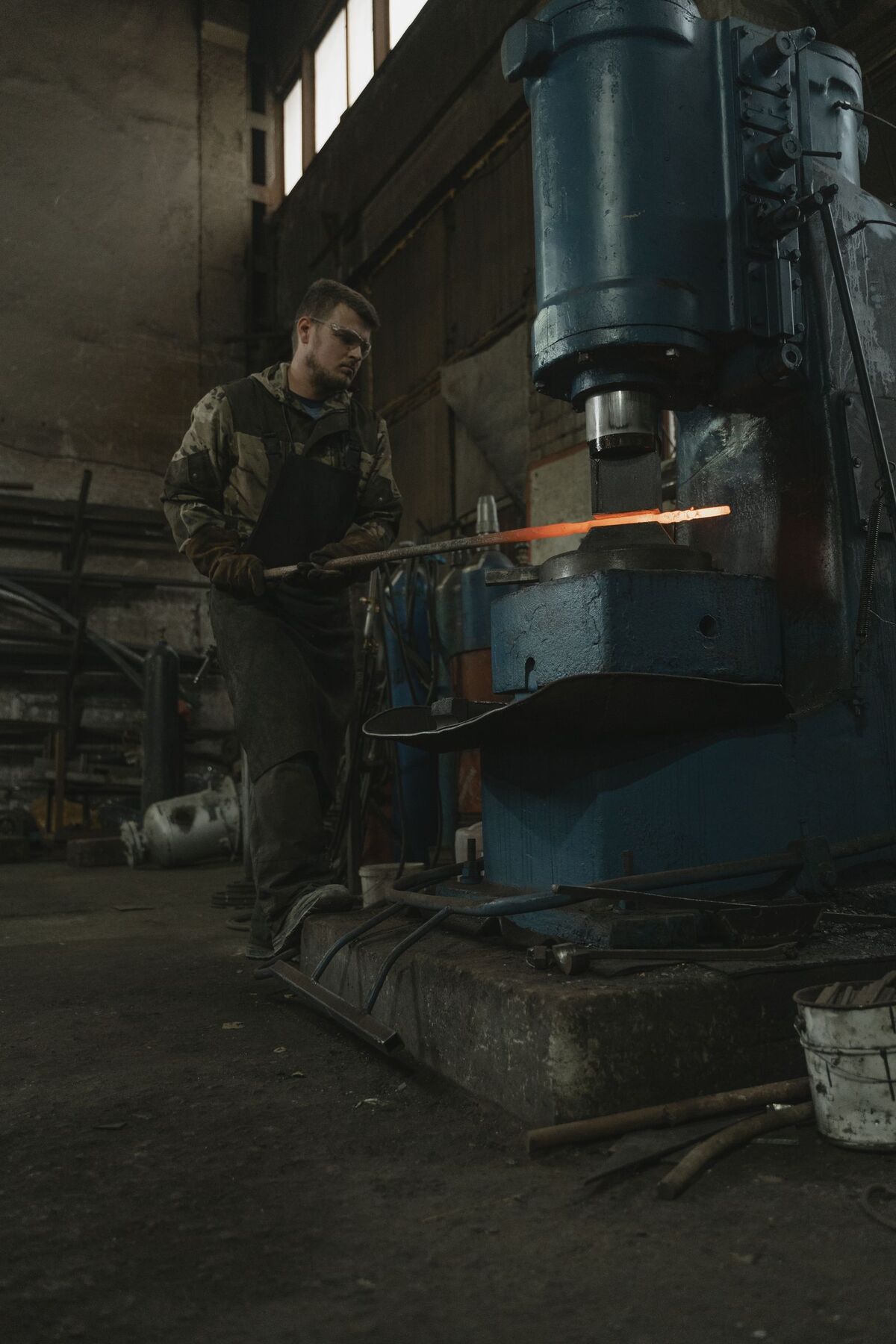
Not every forged part justifies making a die. For a prototype, a one-off part or a short run, Gazo Forge Industrie uses open-die forging: flexible production, quick to set up, with no tooling investment.
What is open-die forging?
In open-die forging, the heated metal is shaped by successive blows on a power hammer, between simple, unengraved tools. The forger's skill guides the part towards its shape, pass after pass, rather than a cavity fixing it in a single blow. Dimensions are then brought to their final values by machining.
Operations we perform
- Drawing out: lengthening a bar by reducing its cross-section.
- Upsetting: shortening a bar to increase its cross-section, for example to form a head or a collar.
- Bick forging: shaping ring-shaped or curved parts on the anvil horn.
- Bending and rolling: bending or flattening a part while hot.
- Simple swaging: locally shaping the part with striking tools.
When to choose open-die forging over stamping?
Open-die forging suits low quantities, short lead times, or parts that need validating before investing in a die. It is also well suited to hard-to-find spare parts, remade from a sample or a drawing. As the series grows, stamping takes over: our engineers help you choose between the two processes based on quantity, shape and target cost.
The benefits of a forged part
Even without a die, a forged part keeps the qualities of hot forging: compact metal, oriented grain flow and good mechanical strength, superior to a part cut or machined directly from bar. We forge carbon steels, alloy and low-alloy steels, and stainless steels.
A finished part, not just a forging
After forging, we carry out heat treatment (quenching and tempering, normalising), machining by turning, milling or grinding, and inspection of material and product. Our engineering office can also help you define the part from a worn sample or a simple sketch.